Development of Surfactant-Modified Natural Zeolite for Triclosan Adsorption
DOI:
https://doi.org/10.22452/mjs.vol45no3.9Keywords:
Triclosan, personal care products, natural zeolite, wastewater, surfactant modification, adsorptionAbstract
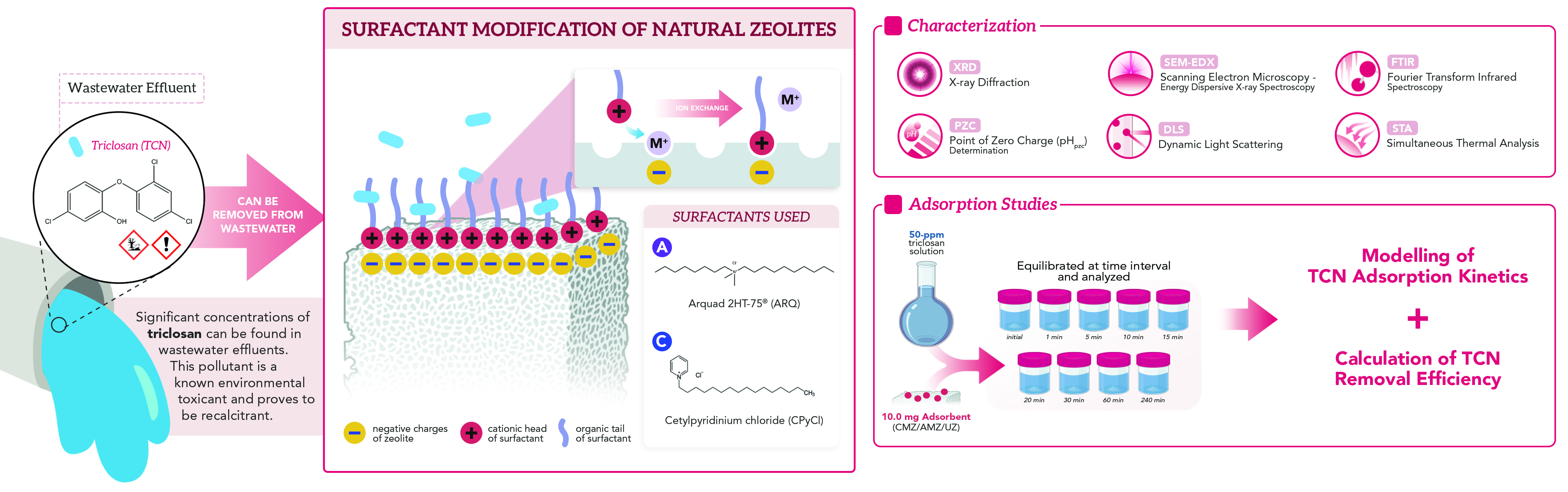
Triclosan (TCN) is a common antimicrobial and antifungal agent employed in pharmaceutical and personal care products (PPCPs). The persistent inability to completely remove TCN from wastewater has led to its accumulation across various wastewater matrices. Given the ecological and health consequences of TCN pollution, methods to prevent its entry into the wider aquatic environment are necessary. Due to its adsorption efficacy and abundance, Philippine natural zeolite (PNZ) is a promising candidate for environmental remediation as an effective adsorbent of charged contaminants. However, these natural zeolites have limited adsorption utility for non-polar species. To overcome this limitation, surfactant modification of natural zeolites was investigated to enable their adsorption of TCN. In this study, modification was achieved using cetylpyridinium chloride (CPyCl) and Arquad® 2HT-75 (ARQ) solutions prepared at 100% of the external cation exchange capacity of the zeolites, which yielded surfactant-modified natural zeolites (SMNZ) with a monolayer surfactant layer. Using Fourier-Transform Infrared Spectroscopy, Dynamic Light Scattering, Energy Dispersive X-ray Spectroscopy, and Simultaneous Thermal Analysis, surfactant modification was confirmed by the presence of distinct responses characteristic of surfactants in SMNZs that differentiate them from unmodified zeolite (UZ). TCN adsorption was investigated at varying pH (7, 8, and 9) and at varying adsorbent exposure times. Kinetic models (pseudo-first order, pseudo-second order, Elovich, and Weber-Morris interparticle diffusion) were fitted to the adsorption data, which revealed that TCN adsorption was best modeled by the pseudo-second order model. Surfactant modification yielded SMNZs with markedly improved TCN removal of up to 82% from a 50 ppm solution, in contrast to the unmodified zeolites, while reaching equilibration at >30 minutes. Overall, SMNZ showed effective removal of TCN and represents a potentially viable adsorbent for effective real-world wastewater treatment.
References
Afzal, M. (2000). TG and DTA Study of the Thermal Dehydration of Metal-exchanged Zeolite-4A Samples. Journal of Thermal Analysis and Calorimetry, 62(3), 721–727. https://doi.org/10.1023/A:1026725509732
Agyin‐Birikorang, S., Miller, M., & O’Connor, G. A. (2010). Retention‐release characteristics of triclocarban and triclosan in biosolids, soils, and biosolids‐amended soils. Environmental Toxicology and Chemistry, 29(9), 1925–1933. https://doi.org/10.1002/etc.251
Al-Mashaqbeh, O. A., Alsafadi, D. A., Alsalhi, L. Z., Bartelt-Hunt, S. L., & Snow, D. D. (2021). Removal of Carbamazepine onto Modified Zeolitic Tuff in Different Water Matrices: Batch and Continuous Flow Experiments. Water, 13(8), 1084. https://doi.org/10.3390/w13081084
Apreutesei, R. E., Catrinescu, C., & Teodosiu, C. (2008). SURFACTANT-MODIFIED NATURAL ZEOLITES FOR ENVIRONMENTAL APPLICATIONS IN WATER PURIFICATION. Environmental Engineering and Management Journal, 7(2), 149–161. https://doi.org/10.30638/eemj.2008.025
Armbruster, T., & Gunter, M. E. (2001). Crystal Structures of Natural Zeolites. Reviews in Mineralogy and Geochemistry, 45(1), 1–67. https://doi.org/10.2138/rmg.2001.45.1
Bagheri, A., Yazdani, A., & Abbas Rafati, A. (2024). Selection of better cationic surfactant for zeolite modification using surface studies and its application in the removal of anionic and cationic dyes. Journal of Molecular Liquids, 403, 124881. https://doi.org/10.1016/j.molliq.2024.124881
Baird, R., & Bridgewater, L. (2017). Standard methods for the examination of water and wastewater (23rd Edition). American Public Health Association.
Bajpai, D., & Tyagi, V. K. (2010). Nonionic Surfactants: An Overview. Tenside Surfactants Detergents, 47(3), 190–196. https://doi.org/10.3139/113.110062
Cabrera, C., Gabaldón, C., & Marzal, P. (2005). Sorption characteristics of heavy metal ions by a natural zeolite. Journal of Chemical Technology & Biotechnology, 80(4), 477–481. https://doi.org/10.1002/jctb.1189
Cappelletti, P., Colella, A., Langella, A., Mercurio, M., Catalanotti, L., Monetti, V., & De Gennaro, B. (2017). Use of surface modified natural zeolite (SMNZ) in pharmaceutical preparations Part 1. Mineralogical and technological characterization of some industrial zeolite-rich rocks. Microporous and Mesoporous Materials, 250, 232–244. https://doi.org/10.1016/j.micromeso.2015.05.048
Chen, X., Liang, J., Bao, L., Gu, X., Zha, S., & Chen, X. (2022). Competitive and cooperative sorption between triclosan and methyl triclosan on microplastics and soil. Environmental Research, 212, 113548. https://doi.org/10.1016/j.envres.2022.113548
Dar, O. I., Aslam, R., Pan, D., Sharma, S., Andotra, M., Kaur, A., Jia, A.-Q., & Faggio, C. (2022). Source, bioaccumulation, degradability and toxicity of triclosan in aquatic environments: A review. Environmental Technology & Innovation, 25, 102122. https://doi.org/10.1016/j.eti.2021.102122
De Gennaro, B., Mercurio, M., Cappelletti, P., Catalanotti, L., Daković, A., De Bonis, A., Grifa, C., Izzo, F., Kraković, M., Monetti, V., & Langella, A. (2016). Use of surface modified natural zeolite (SMNZ) in pharmaceutical preparations. Part 2. A new approach for a fast functionalization of zeolite-rich carriers. Microporous and Mesoporous Materials, 235, 42–49. https://doi.org/10.1016/j.micromeso.2016.07.043
Elboughdiri, N. (2020). The use of natural zeolite to remove heavy metals Cu (II), Pb (II) and Cd (II), from industrial wastewater. Cogent Engineering, 7(1), 1782623. https://doi.org/10.1080/23311916.2020.1782623
Hailu, S. L., Nair, B. U., Redi-Abshiro, M., Diaz, I., & Tessema, M. (2017). Preparation and characterization of cationic surfactant modified zeolite adsorbent material for adsorption of organic and inorganic industrial pollutants. Journal of Environmental Chemical Engineering, 5(4), 3319–3329. https://doi.org/10.1016/j.jece.2017.06.039
Jiménez-Castañeda, M., & Medina, D. (2017). Use of Surfactant-Modified Zeolites and Clays for the Removal of Heavy Metals from Water. Water, 9(4), 235. https://doi.org/10.3390/w9040235
Korkuna, O., Leboda, R., Skubiszewska-Zie¸ba, J., Vrublevs’ka, T., Gun’ko, V. M., & Ryczkowski, J. (2006). Structural and physicochemical properties of natural zeolites: Clinoptilolite and mordenite. Microporous and Mesoporous Materials, 87(3), 243–254. https://doi.org/10.1016/j.micromeso.2005.08.002
Krajišnik, D., Daković, A., Malenović, A., Milojević-Rakić, M., Dondur, V., Radulović, Ž., & Milić, J. (2013). Investigation of adsorption and release of diclofenac sodium by modified zeolites composites. Applied Clay Science, 83–84, 322–326. https://doi.org/10.1016/j.clay.2013.08.011
Król, M. K., & Jeleń, P. (2021). The Effect of Heat Treatment on the Structure of Zeolite A. Materials, 14(16), 4642. https://doi.org/10.3390/ma14164642
Li, Z. (1999). Sorption Kinetics of Hexadecyltrimethylammonium on Natural Clinoptilolite. Langmuir, 15(19), 6438–6445. https://doi.org/10.1021/la981535x
Lin, J. W., Zhan, Y. X., & Lu, X. (2012). Adsorption of phosphate and ammonium from aqueous solution on zirconium modified zeolite. China Environmental Science, 32(11). https://doi.org/10.0000/j.zghjkx.1000-6923.20123213089
Lin, J., Zhan, Y., Zhu, Z., & Xing, Y. (2011). Adsorption of tannic acid from aqueous solution onto surfactant-modified zeolite. Journal of Hazardous Materials, 193, 102–111. https://doi.org/10.1016/j.jhazmat.2011.07.035
Luo, Z., He, Y., Zhi, D., Luo, L., Sun, Y., Khan, E., Wang, L., Peng, Y., Zhou, Y., & Tsang, D. C. W. (2019). Current progress in treatment techniques of triclosan from wastewater: A review. Science of The Total Environment, 696, 133990. https://doi.org/10.1016/j.scitotenv.2019.133990
Maksymowicz, M., Machowiec, P., Ręka, G., Korzeniowska, A., Leszczyk, P., & Piecewicz-Szczęsna, H. (2021). Mechanism of action of triclosan as an endocrine-disrupting chemical with its impact on human health – literature review. Journal of Pre-Clinical and Clinical Research, 15(4), 169–175. https://doi.org/10.26444/jpccr/142065
Margeta, K., Zabukovec, N., Siljeg, M., & Farkas, A. (2013). Natural Zeolites in Water Treatment – How Effective is Their Use. In W. Elshorbagy (Ed.), Water Treatment. InTech. https://doi.org/10.5772/50738
Marques, A. C., Mariana, M., & Cairrao, E. (2022). Triclosan and Its Consequences on the Reproductive, Cardiovascular and Thyroid Levels. International Journal of Molecular Sciences, 23(19), 11427. https://doi.org/10.3390/ijms231911427
Nodehi, R., Shayesteh, H., & Kelishami, A. R. (2020). Enhanced adsorption of congo red using cationic surfactant functionalized zeolite particles. Microchemical Journal, 153, 104281. https://doi.org/10.1016/j.microc.2019.104281
Panek, R., Wdowin, M., & Franus, W. (2014). The Use of Scanning Electron Microscopy to Identify Zeolite Minerals. In E. K. Polychroniadis, A. Y. Oral, & M. Ozer (Eds.), International Multidisciplinary Microscopy Congress (Vol. 154, pp. 45–50). Springer International Publishing. https://doi.org/10.1007/978-3-319-04639-6_7
Peñafiel, M. E., Jara-Cobos, L., Flores, D., Jerves, C., & Menendez, M. (2024). Enhancing adsorptive removal of diclofenac from aqueous solution: Evaluating organic and inorganic acid treatment of zeolite. Case Studies in Chemical and Environmental Engineering, 9, 100575. https://doi.org/10.1016/j.cscee.2023.100575
Pérez-Botella, E., Valencia, S., & Rey, F. (2022). Zeolites in Adsorption Processes: State of the Art and Future Prospects. Chemical Reviews, 122(24), 17647–17695. https://doi.org/10.1021/acs.chemrev.2c00140
Reeve, P. J., & Fallowfield, H. J. (2018). Natural and surfactant modified zeolites: A review of their applications for water remediation with a focus on surfactant desorption and toxicity towards microorganisms. Journal of Environmental Management, 205, 253–261. https://doi.org/10.1016/j.jenvman.2017.09.077
Revellame, E. D., Fortela, D. L., Sharp, W., Hernandez, R., & Zappi, M. E. (2020). Adsorption kinetic modeling using pseudo-first order and pseudo-second order rate laws: A review. Cleaner Engineering and Technology, 1, 100032. https://doi.org/10.1016/j.clet.2020.100032
Sahoo, T. R., & Prelot, B. (2020). Adsorption processes for the removal of contaminants from wastewater. In Nanomaterials for the Detection and Removal of Wastewater Pollutants (pp. 161–222). Elsevier. https://doi.org/10.1016/B978-0-12-818489-9.00007-4
Sakizci, M., & Özgül Tanriverdi̇, L. (2015). Influence of acid and heavy metal cation exchange treatments on methane adsorption properties of mordenite. TURKISH JOURNAL OF CHEMISTRY, 39, 970–983. https://doi.org/10.3906/kim-1501-71
Sarkar, R., Pal, A., Rakshit, A., & Saha, B. (2021). Properties and applications of amphoteric surfactant: A concise review. Journal of Surfactants and Detergents, 24(5), 709–730. https://doi.org/10.1002/jsde.12542
Shi, J., Yang, Z., Dai, H., Lu, X., Peng, L., Tan, X., Shi, L., & Fahim, R. (2018). Preparation and application of modified zeolites as adsorbents in wastewater treatment. Water Science and Technology, 2017(3), 621–635. https://doi.org/10.2166/wst.2018.249
Smiljanić, D., Daković, A., Obradović, M., Ožegović, M., Izzo, F., Germinario, C., & De Gennaro, B. (2021). Application of Surfactant Modified Natural Zeolites for the Removal of Salicylic Acid—A Contaminant of Emerging Concern. Materials, 14(24), 7728. https://doi.org/10.3390/ma14247728
Smiljanić, D., De Gennaro, B., Daković, A., Galzerano, B., Germinario, C., Izzo, F., Rottinghaus, G. E., & Langella, A. (2021). Removal of non-steroidal anti-inflammatory drugs from water by zeolite-rich composites: The interference of inorganic anions on the ibuprofen and naproxen adsorption. Journal of Environmental Management, 286, 112168. https://doi.org/10.1016/j.jenvman.2021.112168
Smiljanić, D., De Gennaro, B., Izzo, F., Langella, A., Daković, A., Germinario, C., Rottinghaus, G. E., Spasojević, M., & Mercurio, M. (2020). Removal of emerging contaminants from water by zeolite-rich composites: A first approach aiming at diclofenac and ketoprofen. Microporous and Mesoporous Materials, 298, 110057. https://doi.org/10.1016/j.micromeso.2020.110057
Sun, C., Zhang, T., Zhou, Y., Liu, Z., Zhang, Y., Bian, Y., & Feng, X. (2023). Triclosan and related compounds in the environment: Recent updates on sources, fates, distribution, analytical extraction, analysis, and removal techniques. Science of The Total Environment, 870, 161885. https://doi.org/10.1016/j.scitotenv.2023.161885
Tran, H. N., Viet, P. V., & Chao, H.-P. (2018). Surfactant modified zeolite as amphiphilic and dual-electronic adsorbent for removal of cationic and oxyanionic metal ions and organic compounds. Ecotoxicology and Environmental Safety, 147, 55–63. https://doi.org/10.1016/j.ecoenv.2017.08.027
Velarde, L., Nabavi, M. S., Escalera, E., Antti, M.-L., & Akhtar, F. (2023). Adsorption of heavy metals on natural zeolites: A review. Chemosphere, 328, 138508. https://doi.org/10.1016/j.chemosphere.2023.138508
Wang, J., & Guo, X. (2020). Adsorption kinetic models: Physical meanings, applications, and solving methods. Journal of Hazardous Materials, 390, 122156. https://doi.org/10.1016/j.jhazmat.2020.122156
Wang, Y., & Liang, W. (2021). Occurrence, Toxicity, and Removal Methods of Triclosan: A Timely Review. Current Pollution Reports, 7(1), 31–39. https://doi.org/10.1007/s40726-021-00173-9
Wang, Z., Li, X., Liu, H., Zhou, T., Li, J., Li, Y., Lin, C. S. K., & Wang, Q. (2024). Triclosan in sludge: Exploring its journey from the sewage treatment plants to land application and potential impacts on the environment. Critical Reviews in Environmental Science and Technology, 54(18), 1340–1363. https://doi.org/10.1080/10643389.2024.2309846
William Kajjumba, G., Emik, S., Öngen, A., Kurtulus Özcan, H., & Aydın, S. (2019). Modelling of Adsorption Kinetic Processes—Errors, Theory and Application. In S. Edebali (Ed.), Advanced Sorption Process Applications. IntechOpen. https://doi.org/10.5772/intechopen.80495
Wilson, B., Chen, R. F., Cantwell, M., Gontz, A., Zhu, J., & Olsen, C. R. (2009). The partitioning of Triclosan between aqueous and particulate bound phases in the Hudson River Estuary. Marine Pollution Bulletin, 59(4–7), 207–212. https://doi.org/10.1016/j.marpolbul.2009.03.026
Wu, F.-C., Tseng, R.-L., Huang, S.-C., & Juang, R.-S. (2009). Characteristics of pseudo-second-order kinetic model for liquid-phase adsorption: A mini-review. Chemical Engineering Journal, 151(1–3), 1–9. https://doi.org/10.1016/j.cej.2009.02.024
Zorpas, A. A., Pedreño, J. N., & Candel, M. B. A. (2021). Heavy metal treatment and removal using natural zeolites from sewage sludge, compost, and agricultural soils: A review. Arabian Journal of Geosciences, 14(12), 1098. https://doi.org/10.1007/s12517-021-07443-2
Downloads
Published
Issue
Section
License
Copyright (c) 2026 Malaysian Journal of Science (MJS)

This work is licensed under a Creative Commons Attribution-NonCommercial 4.0 International License.
Transfer of Copyrights
- In the event of publication of the manuscript entitled [INSERT MANUSCRIPT TITLE AND REF NO.] in the Malaysian Journal of Science, I hereby transfer copyrights of the manuscript title, abstract and contents to the Malaysian Journal of Science and the Faculty of Science, University of Malaya (as the publisher) for the full legal term of copyright and any renewals thereof throughout the world in any format, and any media for communication.
Conditions of Publication
- I hereby state that this manuscript to be published is an original work, unpublished in any form prior and I have obtained the necessary permission for the reproduction (or am the owner) of any images, illustrations, tables, charts, figures, maps, photographs and other visual materials of whom the copyrights is owned by a third party.
- This manuscript contains no statements that are contradictory to the relevant local and international laws or that infringes on the rights of others.
- I agree to indemnify the Malaysian Journal of Science and the Faculty of Science, University of Malaya (as the publisher) in the event of any claims that arise in regards to the above conditions and assume full liability on the published manuscript.
Reviewer’s Responsibilities
- Reviewers must treat the manuscripts received for reviewing process as confidential. It must not be shown or discussed with others without the authorization from the editor of MJS.
- Reviewers assigned must not have conflicts of interest with respect to the original work, the authors of the article or the research funding.
- Reviewers should judge or evaluate the manuscripts objective as possible. The feedback from the reviewers should be express clearly with supporting arguments.
- If the assigned reviewer considers themselves not able to complete the review of the manuscript, they must communicate with the editor, so that the manuscript could be sent to another suitable reviewer.
Copyright: Rights of the Author(s)
- Effective 2007, it will become the policy of the Malaysian Journal of Science (published by the Faculty of Science, University of Malaya) to obtain copyrights of all manuscripts published. This is to facilitate:
- Protection against copyright infringement of the manuscript through copyright breaches or piracy.
- Timely handling of reproduction requests from authorized third parties that are addressed directly to the Faculty of Science, University of Malaya.
- As the author, you may publish the fore-mentioned manuscript, whole or any part thereof, provided acknowledgement regarding copyright notice and reference to first publication in the Malaysian Journal of Science and Faculty of Science, University of Malaya (as the publishers) are given. You may produce copies of your manuscript, whole or any part thereof, for teaching purposes or to be provided, on individual basis, to fellow researchers.
- You may include the fore-mentioned manuscript, whole or any part thereof, electronically on a secure network at your affiliated institution, provided acknowledgement regarding copyright notice and reference to first publication in the Malaysian Journal of Science and Faculty of Science, University of Malaya (as the publishers) are given.
- You may include the fore-mentioned manuscript, whole or any part thereof, on the World Wide Web, provided acknowledgement regarding copyright notice and reference to first publication in the Malaysian Journal of Science and Faculty of Science, University of Malaya (as the publishers) are given.
- In the event that your manuscript, whole or any part thereof, has been requested to be reproduced, for any purpose or in any form approved by the Malaysian Journal of Science and Faculty of Science, University of Malaya (as the publishers), you will be informed. It is requested that any changes to your contact details (especially e-mail addresses) are made known.
Copyright: Role and responsibility of the Author(s)
- In the event of the manuscript to be published in the Malaysian Journal of Science contains materials copyrighted to others prior, it is the responsibility of current author(s) to obtain written permission from the copyright owner or owners.
- This written permission should be submitted with the proof-copy of the manuscript to be published in the Malaysian Journal of Science
Licensing Policy
Malaysian Journal of Science is an open-access journal that follows the Creative Commons Attribution-Non-commercial 4.0 International License (CC BY-NC 4.0)
CC BY – NC 4.0: Under this licence, the reusers to distribute, remix, alter, and build upon the content in any media or format for non-commercial purposes only, as long as proper acknowledgement is given to the authors of the original work. Please take the time to read the whole licence agreement (https://creativecommons.org/licenses/by-nc/4.0/legalcode ).