Morphological Characterization of 10 Clones of Superior Sugarcane (Saccharum officinarum L.) Mutants Resulting from Colchicine Induction at PT Gunung Madu Plantations
DOI:
https://doi.org/10.22452/mjs.vol45no3.3Keywords:
sugarcane, colchicine, superior clones, morphology, relationshipsAbstract
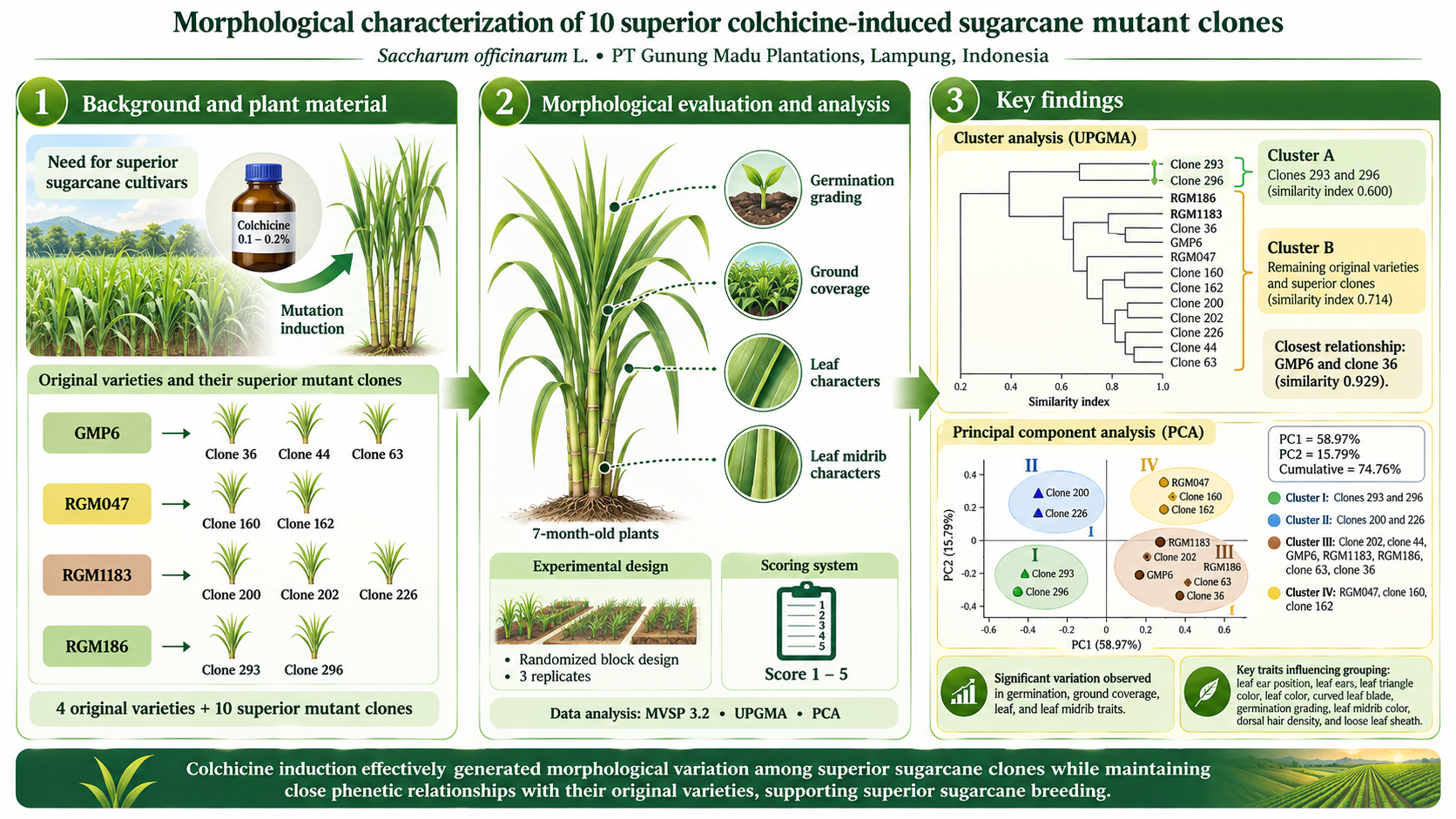
Sugarcane (Saccharum officinarum L.) is a sugar-producing plant commonly cultivated in tropical climates. However, frequent decline in its productivity often results in unmet sugar demand. Sugarcane breeding techniques are thus required to increase productivity using the chemical mutagen colchicine. This study aims to evaluate the diversity of morphological traits of 10 superior mutant sugarcane clones induced by colchicine, derived from the varieties GMP6, RGM047, RGM1183, and RGM186. It was conducted at PT Gunung Madu Plantations using a randomized block design. Experimental units were grouped according to their original variety GMP6 (clones 36, 44, and 63), RGM047 (clones 160 and 162), RGM1183 (clones 200, 202, and 226), and RGM186 (clones 293 and 296), with 3 replicates. The parameters observed included germination grading, ground cover, leaves, and leaf midribs. Data analysis was performed using the Multivariate Statistics Package (MVSP) version 3.2, and genetic distance was used in cluster analysis using the Unweighted Pair Group Method with Arithmetic Mean (UPGMA). The results indicated significant differences in germination, ground coverage, leaf, and frond characteristics. Cluster analysis revealed a relatively close phenetic relationship between the original varieties and their superior mutant clones. These results suggest that colchicine induction effectively generates genetic variation among the 10 superior mutant sugarcane clones.
References
Aili, EN, Arifin, NS, and Respatijarti. 2016. Effect of Colchicine Administration on the Phenotypic Appearance of Feed Corn Inhybrid Lines (Zea mays L.) In the Vegetative Growth Phase. Journal of Crop Production. 4(5): 370-377.
Allafe, MAO and Asma, RSA 2022. Influence of Colchicine Concentrations on Wheat Seeds Germination and Seedling Quality. Dlyala Agricultural Science Journal. 14(1) : 66-72
Anggraeni and Iriawati. 2017. Lilium longiflorum anther responseThunb. with Various Stages of Microspore Development in Combinations of Growth Regulatory Substance Concentrations. Journal of Agricultural Science and Technology. 1(2): 49-55.
Chandrasekaran, B., Annadurai, B., and Somasundaran E. 2010. A Text Book of Agronomy. New Age International Limited, Publishers. New Delhi.
Fajriani, B., Ni Wayan, SS, Dirvamena, B., Suib, and Teguh, W. 2012. Genetic Variability of Important Agronomic Traits of Several Local Sweet Potato Cones Cultivated in Villages on the Suburbs of Kendari City. Periodic Agronomic Research. 1(1): 95-101.
Food and Agriculture Organization. 2020. Current world fertilizer trends and outlook for 2018. Food and Agriculture Organization of the United Nations. Rome.
Hamida, R. and Parnidi. 2019. Relationships of Sugarcane Germplasm Based on Morphological Characters. Tobacco Plant, Fiber and Oil Industry Bulletin. 11(1) : 24-32.
Hapsoro, D. 2019. In Vitro Culture of Sugarcane Plants and Its Benefits for Mutagenesis Using Gamma Rays. CV. Raharja's Main Gift. Lampung.
Isnani, JL, Sunniati, and Asmawati. 2015. Growth of Sugarcane Plant Cuttings (Saccharum officinarum L.) At Various Concentrations of Liquid Organic Fertilizer Solutions. Agrocomplex Journal . 14(1) : 46-49.
Kendari, P. 2022. Analysis of Agronomic, Anatomical and Molecular Characters in the Sugarcane Cultivar (Saccharum officinarum L.) GMP3 Result of Breeding Through Colchicine Induction. Thesis.
Manseh, JK, Akomeah, PA, and Ekpekurede, EO. 2005. Gamma radiation induced variation of yield parameters in cowpea (Vigna unguiculata (L) Walp). Global Journal Pure Appl. Sci. 11(3) : 327-330.
Rasyid, AFG, and Wisya, A. 2020. Trends in Information Literacy of New Students in Plant Morphology Courses. Journal of Educational Research. 8(2) : 145-144.
Simamora, Y. 2021. Effect of Colchicine Mutation Induction on Agronomics of Sugarcane Varieties (Saccharum officinarum L.) Commercial. Field Work Practices.
Widiastuti, RP Bambang, TR, and Hagus, T. 2014. Resistance of Several Commercial Sugarcane Varieties to Attacks by Glossy Stem Borer Pests Chilo auricilius Dudgeon (Lepidoptera : Pyralidae) in the Greenhouse. HPT Journal. 2(2): 38-46.
Yuniyanti, N., Trikoesoeningtyas, Hartati, and Suhesti. 2022. Colchicine Induces Morphological Variability in Sugarcane. International Conference.
Downloads
Published
Issue
Section
License
Copyright (c) 2026 Malaysian Journal of Science (MJS)

This work is licensed under a Creative Commons Attribution-NonCommercial 4.0 International License.
Transfer of Copyrights
- In the event of publication of the manuscript entitled [INSERT MANUSCRIPT TITLE AND REF NO.] in the Malaysian Journal of Science, I hereby transfer copyrights of the manuscript title, abstract and contents to the Malaysian Journal of Science and the Faculty of Science, University of Malaya (as the publisher) for the full legal term of copyright and any renewals thereof throughout the world in any format, and any media for communication.
Conditions of Publication
- I hereby state that this manuscript to be published is an original work, unpublished in any form prior and I have obtained the necessary permission for the reproduction (or am the owner) of any images, illustrations, tables, charts, figures, maps, photographs and other visual materials of whom the copyrights is owned by a third party.
- This manuscript contains no statements that are contradictory to the relevant local and international laws or that infringes on the rights of others.
- I agree to indemnify the Malaysian Journal of Science and the Faculty of Science, University of Malaya (as the publisher) in the event of any claims that arise in regards to the above conditions and assume full liability on the published manuscript.
Reviewer’s Responsibilities
- Reviewers must treat the manuscripts received for reviewing process as confidential. It must not be shown or discussed with others without the authorization from the editor of MJS.
- Reviewers assigned must not have conflicts of interest with respect to the original work, the authors of the article or the research funding.
- Reviewers should judge or evaluate the manuscripts objective as possible. The feedback from the reviewers should be express clearly with supporting arguments.
- If the assigned reviewer considers themselves not able to complete the review of the manuscript, they must communicate with the editor, so that the manuscript could be sent to another suitable reviewer.
Copyright: Rights of the Author(s)
- Effective 2007, it will become the policy of the Malaysian Journal of Science (published by the Faculty of Science, University of Malaya) to obtain copyrights of all manuscripts published. This is to facilitate:
- Protection against copyright infringement of the manuscript through copyright breaches or piracy.
- Timely handling of reproduction requests from authorized third parties that are addressed directly to the Faculty of Science, University of Malaya.
- As the author, you may publish the fore-mentioned manuscript, whole or any part thereof, provided acknowledgement regarding copyright notice and reference to first publication in the Malaysian Journal of Science and Faculty of Science, University of Malaya (as the publishers) are given. You may produce copies of your manuscript, whole or any part thereof, for teaching purposes or to be provided, on individual basis, to fellow researchers.
- You may include the fore-mentioned manuscript, whole or any part thereof, electronically on a secure network at your affiliated institution, provided acknowledgement regarding copyright notice and reference to first publication in the Malaysian Journal of Science and Faculty of Science, University of Malaya (as the publishers) are given.
- You may include the fore-mentioned manuscript, whole or any part thereof, on the World Wide Web, provided acknowledgement regarding copyright notice and reference to first publication in the Malaysian Journal of Science and Faculty of Science, University of Malaya (as the publishers) are given.
- In the event that your manuscript, whole or any part thereof, has been requested to be reproduced, for any purpose or in any form approved by the Malaysian Journal of Science and Faculty of Science, University of Malaya (as the publishers), you will be informed. It is requested that any changes to your contact details (especially e-mail addresses) are made known.
Copyright: Role and responsibility of the Author(s)
- In the event of the manuscript to be published in the Malaysian Journal of Science contains materials copyrighted to others prior, it is the responsibility of current author(s) to obtain written permission from the copyright owner or owners.
- This written permission should be submitted with the proof-copy of the manuscript to be published in the Malaysian Journal of Science
Licensing Policy
Malaysian Journal of Science is an open-access journal that follows the Creative Commons Attribution-Non-commercial 4.0 International License (CC BY-NC 4.0)
CC BY – NC 4.0: Under this licence, the reusers to distribute, remix, alter, and build upon the content in any media or format for non-commercial purposes only, as long as proper acknowledgement is given to the authors of the original work. Please take the time to read the whole licence agreement (https://creativecommons.org/licenses/by-nc/4.0/legalcode ).