Evaluating The Suitability of Sunflowers as Companion Plants in an Intercropping System with Tomatoes
DOI:
https://doi.org/10.22452/mjs.vol44no4.1Keywords:
intercropping, monocropping, sunflower, tomato, weedAbstract
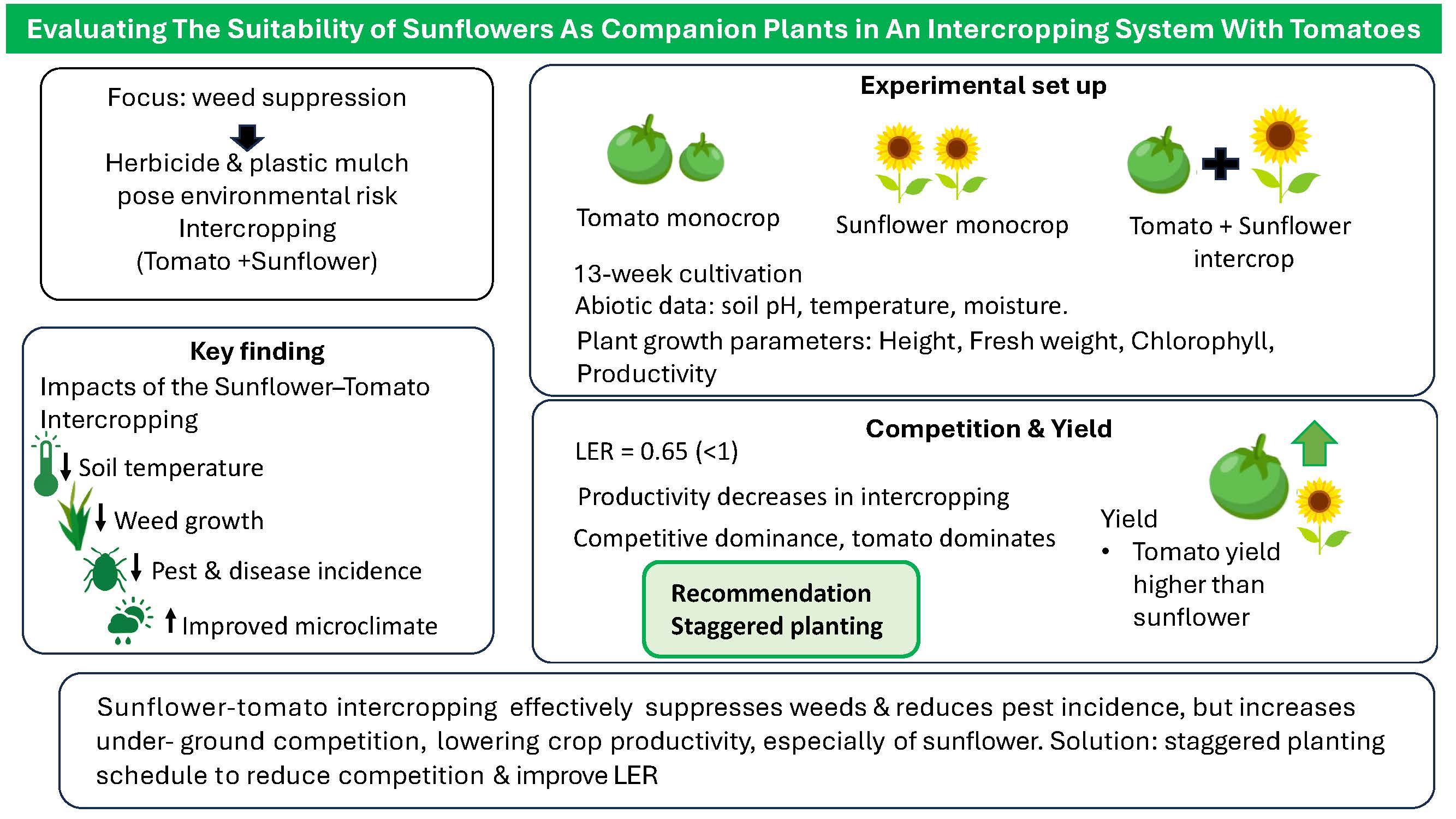
The intercropping system involves growing multiple crop species simultaneously on the same land to reduce the risk of crop failure. One such example is the co-cultivation of sunflowers and tomatoes, where sunflowers function as living mulch. However, studies on the function and impact of sunflower–tomato intercropping systems, particularly in relation to weed management and productivity enhancement in Indonesia, remain limited. This study aims to evaluate the suitability of sunflower plants as companion and living mulch species in intercropping systems with tomatoes, and to assess the performance of both crops when grown individually or together. A randomized block design with two replications per treatment was employed using raised beds. Both crops were transplanted simultaneously in alternating arrangements for 13 weeks at a 1:1 ratio. Results showed that intercropping effectively suppressed weed growth and reduced pest and disease incidence. The Mann–Whitney test (P < 0.05) revealed significantly lower sunflower yields in the intercropping system than in monocropping. A Land Equivalent Ratio (LER) of 0.65 (<1) indicated higher productivity under monocropping, due to intense belowground interspecific competition and rhizosphere interactions. Competition analysis showed that tomatoes dominated the system (Aggressiveness, A = +0.165; Competition Ratio, CR = 1.677). Therefore, sunflower and tomato plants can be effectively intercropped, provided that planting times are staggered to minimize competition and aggressiveness between species.
References
Asare-Bediako E, Addo-Quaye AA, Mohammed A. (2010). Control of Diamondback Moth (Plutella xylostella) on cabbage (Brassica oleracea var. capitata) using intercropping with non-host crops. American Journal of Food Tecnology, 5(4): 269-274.
Bilalis D, Papastylianou P, Konstantas A, Patsiali S, Karkanis A, Efthimiadou A. (2010). Weed-suppressive effects of maize-legume intercropping in organic farming. International Journal of Pest Management 56(2): 173—181
Boudreau MA. (2013). Diseases in intercropping systems. Annual Review of Phytopathology 51: 499–519
Chipomho J, Mapope N, Masuka B, Ngezimana W, Chipomho C. (2015) The influence of cropping system and maize-bean intercrop spatial patterns on companion crop yield weed density and biomass. International Journal of Agriculture and Crop Sciences 8(5): 697—705.
Cunha-Chiamolera TPL. (2017). Agronomic and economic feasibility of tomato and lettuce intecropping in a soilless system as a function of electrical conductivity of the nutrient solution. HortScience 52(9): 1195—1200
Dagustu N, Bayram G, Sincik M, Bayraktaroglu M. (2012). The short breeding cycle protocol effective on diverse genotypes of sunflower (Helianthus annuus L.) Turkish Journal of Field Crops, 17(2):124-128
Degri MM, Samaila AE. (2014). Impact of intercropping tomato and maize on the infestation of tomato fruit borer [Helicoverpa armigera (Hubner)] Journal of Agricultural and Crop Research 2(8) 160-164.
Doran JW, Zeiss MR. (2000). Soil health and sustainability: managing the biotic component of soil quality. Appl Soil Ecol. 15: 3–11.
El-Mehy AA, Mohamed MHM. (2018). Yield and economic evaluation of maize and tomato as effected by cropping systems and some growth stimulants. Middle East Journal of Applied 8(1): 209 — 222.
Freitas AR, De Freitas FCL, de Souza CM, J.C. Zanuncio et al. (2021) Biodegradable mulch controls weeds and increases water use efficiency in lettuce crops. Horticultura Brasileira, 39(3): 330-334
Fukai S, Trenbath BR. (1993). Processes determining intercrop productivity and yields of component crops. Field Crop Research, 34: 247-271
Gitari HI, Nyawade SO, Kamau S, Karanja NN, Gachene CKK, Raza MA, Maitra S, Schulte-Geldermann E. (2020). Revisiting intercropping indices with respect to potato-legume intercropping systems Field Crops Research 258: 107957
Gao Y, Duan AW, Qiu XQ, Liu ZG, Sun JS, Zhang JP. (2010). Distribution and use efficiency of photosynthetically active radiation in strip intercropping of maize and soybean. Journal of Agriculture 102: 1149—1157.
Gonzalez-Chang M, Tiwari S, Sharma S, Wratten AD. (2019). Habitat management for pest management: Limitations and Prospects. Annals of Entomological Society of America 20(10): 1—16.
Gregory PJ. (2006). Plant Roots Growth, Activity and Interaction with Soils. Blackwell Publishing Ltd. Oxford
Hernandez LF. (2010). Leaf angle and light interception in sunflower (Helianthus annuus L.) role of the petiole’s mechanical and anatomical properties. International Journal of Experimental Botany 79: 109—115.
Hossain MF, Ara N, Uddin MS, Islam MR, Kaisar MO. (2014). Effect of sowing dates on flowering, fruit setting and yield of tomato genotypes. J. Agric. Res., 52(4)
Islam MR, Molla MSH, Main MAK. (2016). Productivity and profitability of intercropping sesame with turmeric at marginal farmers level of Bangladesh. SAARC J. Agri. 14(1): 47-58
Jones Jr JB. (2002). Tomato plant culture in the field, greenhouse, and home garden. 1st ed. CRC Press
Jones Jr JB. (2007). Tomato plant culture in the field, greenhouse, and home garden, 2nd ed. CRC Press
Jurado AS, Fernandes MAS, Videira RA, Peixoto FP, Vicente JAF. (2011). Herbicides: the face and the reverse of the coin. an in vitro approach to the toxicity of herbicides in non-target organisms. In: Kortekamp, A. (eds). 2011. Herbicides and Environment. InTech, Rijeka: 3—44.
Kandhro MN, Tunio S, Rajpar I, Chachar Q. (2014). Allelopathic impact of sorghum and sunflower intercropping on weed management and yield enhancement in cotton. Journal of Agriculture 30(2): 312—318.
Kestha MM, El-Baz MG. (2004). Studies on sunflower-tomato intercropping. Field Crops Research Institute 16: 243—249.
Liu H, Gao Y, Sun JS, Liang YY. (2009). Effect of soil moisture regime on greenhouse tomato yield and its formation under drip irrigation. Journal of Applied Ecology 20(11): 2699—2704.
Lukitasari M. (2018). Mengenal tumbuhan lumut (Bryophyta): Deskripsi, klasifikasi, potensi dan cara mempelejarinya. Media Grafika, Magetan.
Machiani MA, Javanmarda A, Morshedloo MA, Maggi F. (2018). Evaluation of competition, essential oil quality and quantity of peppermint intercropped with soybean. Ind. Crops Prod. 111: 743–754.
Makoi JHJR, Ndakidemi PA. (2012). Allelopathic as protectant, defence, and growth stimulants in legume cereal mixed culture systems. Journal of Crop and Horticultural Science 40(3):1—26
Marsal D, Wicaksono KP, Widaryanto E. (2015). Dinamika perubahan komposisi gulma pada tanaman tebu keprasan di lahan sistem reynoso dan tegalan. Jurnal Produksi Tanaman 3(1) :81—90.
Naika S, van Lidt de Jeude J, de Goffau M, Hilmi M, van Dam B. (2005). Cultivation of tomato production, processing and marketing Agrodok-series No. 17 Agromisa Foundation and CTA, Wageningen
Narwal SS, Malik DS. (1985). Influence of intercropping on the yield and food value of rainfed sunflower and companion legumes. Agricultural Journal 21: 395-401.
Nkansah GO., Owusu EO, Bonsu KO, Dennis EA. (2003). Effect of mulch types on growth, yields, and fruit quality of tomato (Lycopersicon esculentum Mill.). Ghana Journal of Horticulture 5: 55—64.
NPCS Board of Consultants & Engineers. (2015) The complete book on tomato & tomato products manufacturing (cultivation & processing). Asia Pacific Business Press, India:
Onwuka B, Mang B. (2018). Effect of soil temperature on some soil properties and plant growth. Advances in Plants and Agriculture Research 8(1): 34—37.
Owodoyin RO, Ogbeide FI, Oluwole O. (2007). Effect of three mulch types on the growth and Yield of tomato (Lycopersicon esculentum Mill) and weed suppression in Ibadan, Rainforest-savanna transition zone of Nigeria. Tropical Agricultural Research and Extention 10: 53—60.
Panth M, Hassler SC, Baysal-Gurel F (2020) Methods for Management of Soilborne Diseases in Crop Production. Agriculture, 10: 16
Rawal N, Pande KR, Shrestha R, Vista SP (2022). Nutrient use efficiency (NUE) of wheat (Triticum aestivum L.) as affected by NPK fertilization. PLos ONE 17(1): e0262771
Sastroutomo SS (1990) Ekologi gulma. Gramedia Pustaka Indonesia, Jakarta: 141—167
Saudy HS, El-Metwally IM. (2008) Weed management under different patterns of sunflower-soybean intercropping. Journal Central European Agriculture. 10(1): 41—52.
Smith, HA, McSorley R (2000) Intercropping and pest management: a review of major concepts. Journal of Entomology 46: 154—161.
Teame G, Tsegay S, Abrha B. (2017). Effect of organic mulching on soil moisture, yield, and yield contributing component of sesame (Sesamum indicum L.). Journal of Agronomy: 1—6
Wintermans JFGM, De Mots A. (1965). Spectrophotometric characteristics of chlorophylls alpha and beta and their pheophytins in ethanol. Biochimica Et Biophysica ACTA 109: 448—453
Wu C, Ma Y, Wang D, Shan Y, Song X, Hu, H, Ren X, Ma X, Cui J, Ma Y (2022) Integrated microbiology and metabolomics analysis reveal plastic mulch film residue affects soil microorganisms and their metabolic functions. Journal of Hazardous Materials, 423: 127258
Zhao Y, Yan C, Lu S, Wang P, Qiu GY, Li R. (2019). Estimation of chlorophyll content in intertidal mangrove leaves with different thickness using hyperspectral data. Ecological Indicator, 106(105511): 1—13.
Downloads
Published
Issue
Section
License
Copyright (c) 2025 Malaysian Journal of Science

This work is licensed under a Creative Commons Attribution-NonCommercial 4.0 International License.
Transfer of Copyrights
- In the event of publication of the manuscript entitled [INSERT MANUSCRIPT TITLE AND REF NO.] in the Malaysian Journal of Science, I hereby transfer copyrights of the manuscript title, abstract and contents to the Malaysian Journal of Science and the Faculty of Science, University of Malaya (as the publisher) for the full legal term of copyright and any renewals thereof throughout the world in any format, and any media for communication.
Conditions of Publication
- I hereby state that this manuscript to be published is an original work, unpublished in any form prior and I have obtained the necessary permission for the reproduction (or am the owner) of any images, illustrations, tables, charts, figures, maps, photographs and other visual materials of whom the copyrights is owned by a third party.
- This manuscript contains no statements that are contradictory to the relevant local and international laws or that infringes on the rights of others.
- I agree to indemnify the Malaysian Journal of Science and the Faculty of Science, University of Malaya (as the publisher) in the event of any claims that arise in regards to the above conditions and assume full liability on the published manuscript.
Reviewer’s Responsibilities
- Reviewers must treat the manuscripts received for reviewing process as confidential. It must not be shown or discussed with others without the authorization from the editor of MJS.
- Reviewers assigned must not have conflicts of interest with respect to the original work, the authors of the article or the research funding.
- Reviewers should judge or evaluate the manuscripts objective as possible. The feedback from the reviewers should be express clearly with supporting arguments.
- If the assigned reviewer considers themselves not able to complete the review of the manuscript, they must communicate with the editor, so that the manuscript could be sent to another suitable reviewer.
Copyright: Rights of the Author(s)
- Effective 2007, it will become the policy of the Malaysian Journal of Science (published by the Faculty of Science, University of Malaya) to obtain copyrights of all manuscripts published. This is to facilitate:
- Protection against copyright infringement of the manuscript through copyright breaches or piracy.
- Timely handling of reproduction requests from authorized third parties that are addressed directly to the Faculty of Science, University of Malaya.
- As the author, you may publish the fore-mentioned manuscript, whole or any part thereof, provided acknowledgement regarding copyright notice and reference to first publication in the Malaysian Journal of Science and Faculty of Science, University of Malaya (as the publishers) are given. You may produce copies of your manuscript, whole or any part thereof, for teaching purposes or to be provided, on individual basis, to fellow researchers.
- You may include the fore-mentioned manuscript, whole or any part thereof, electronically on a secure network at your affiliated institution, provided acknowledgement regarding copyright notice and reference to first publication in the Malaysian Journal of Science and Faculty of Science, University of Malaya (as the publishers) are given.
- You may include the fore-mentioned manuscript, whole or any part thereof, on the World Wide Web, provided acknowledgement regarding copyright notice and reference to first publication in the Malaysian Journal of Science and Faculty of Science, University of Malaya (as the publishers) are given.
- In the event that your manuscript, whole or any part thereof, has been requested to be reproduced, for any purpose or in any form approved by the Malaysian Journal of Science and Faculty of Science, University of Malaya (as the publishers), you will be informed. It is requested that any changes to your contact details (especially e-mail addresses) are made known.
Copyright: Role and responsibility of the Author(s)
- In the event of the manuscript to be published in the Malaysian Journal of Science contains materials copyrighted to others prior, it is the responsibility of current author(s) to obtain written permission from the copyright owner or owners.
- This written permission should be submitted with the proof-copy of the manuscript to be published in the Malaysian Journal of Science
Licensing Policy
Malaysian Journal of Science is an open-access journal that follows the Creative Commons Attribution-Non-commercial 4.0 International License (CC BY-NC 4.0)
CC BY – NC 4.0: Under this licence, the reusers to distribute, remix, alter, and build upon the content in any media or format for non-commercial purposes only, as long as proper acknowledgement is given to the authors of the original work. Please take the time to read the whole licence agreement (https://creativecommons.org/licenses/by-nc/4.0/legalcode ).