Molecular Identification Based on COX1 Partial Gene of Red Shrimp from Anchialine Habitat at Buton Island, Indonesia
DOI:
https://doi.org/10.22452/mjs.vol45no3.5Keywords:
Buton Island, COX1, molecular identification, Parhippolyte uveaeAbstract
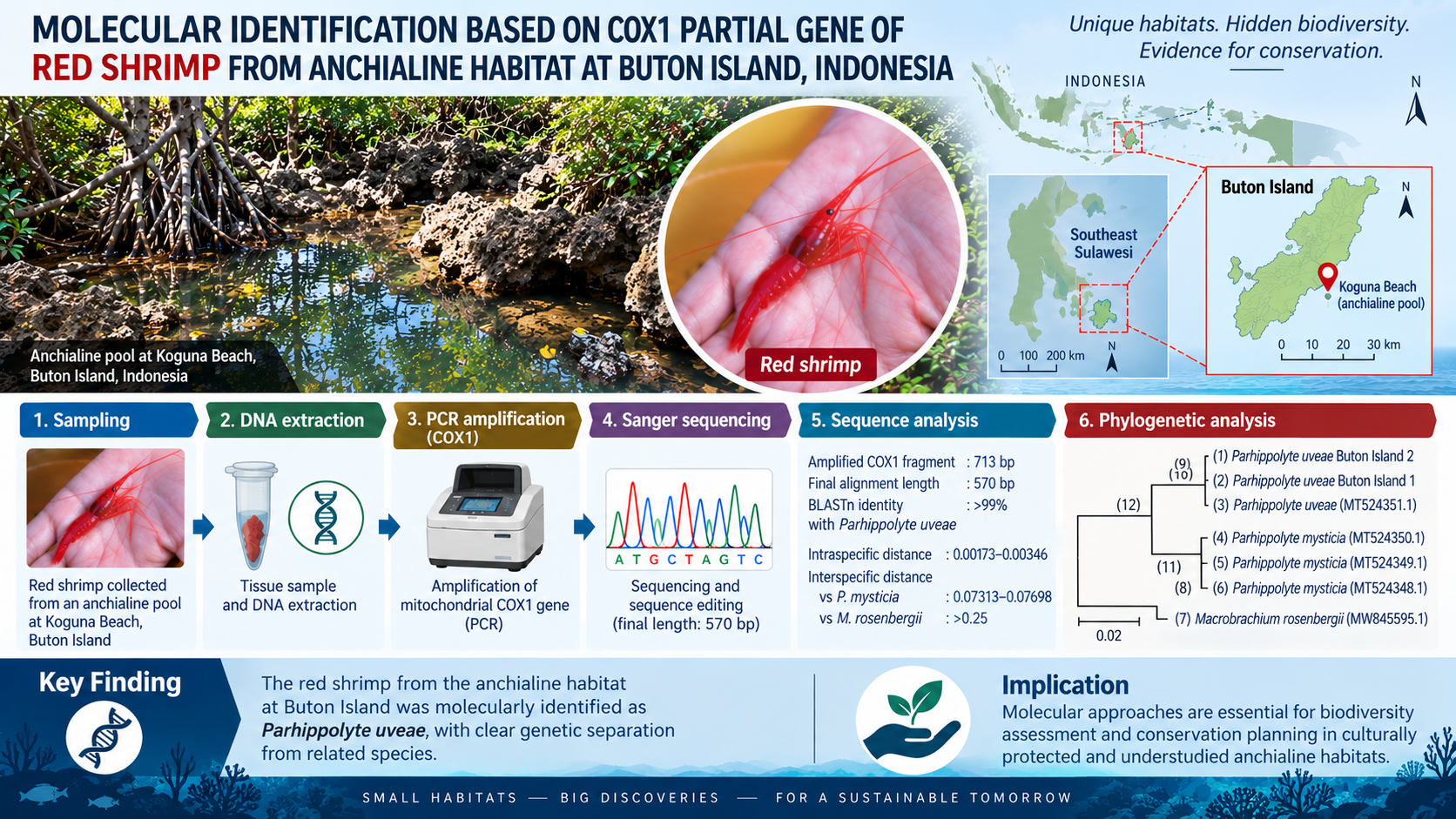
Anchialine ecosystems are unique coastal habitats that remain poorly explored in Indonesia and may support distinctive, endemic, and taxonomically unresolved fauna. In an anchialine pool in the Koguna Beach area on Buton Island, a conspicuous red shrimp has long been observed by local communities, yet its taxonomic identity has remained unresolved. This study aimed to provide the first molecular identification and genetic confirmation of this red shrimp using a partial mitochondrial COX1 gene sequence as a genetic marker. Shrimp tissue samples were collected from the study site and preserved in 96% ethanol. Total DNA was extracted using the DNeasy Blood & Tissue Kit, amplified by polymerase chain reaction (PCR), and sequenced using the Sanger method. The resulting COX1 sequences (713 bp) were trimmed and edited, yielding a final alignment of 570 bp for analysis. BLASTn results showed >99% sequence identity with Parhippolyte uveae. Intraspecific genetic distances were low (0.00173–0.00346), whereas interspecific distances between P. uveae and P. misticia (0.07313–0.07698), and between P. uveae and Macrobrachium rosenbergii (>0.25), supported species-level separation. Phylogenetic reconstruction further clustered the Buton Island samples within the P. uveae clade. In conclusion, molecular analysis supported the identification of the red shrimp from the study site as P. uveae and highlighted the importance of molecular approaches for biodiversity assessment and conservation planning in culturally protected and understudied anchialine habitats.
References
Arisuryanti, T., Sari, R., Ulum, S., Alfianti, A., Ayu, K. L., Hasan, R. L., & Hakim, L. (2020). Genetic characterization of red shrimp (Parhippolyte uveae Borradaile, 1900) from Tanjung Sanjangan (Tolitoli, Central Sulawesi) using COI mitochondrial gene as a barcoding marker. The 6th International Conference on Biological Science ICBS 2019: “Biodiversity as a Cornerstone for Embracing Future Humanity” 10–11 October 2019 Yogyakarta, Indonesia, 020027. https://doi.org/10.1063/5.0015913
Arlyza, I. S., Shen, K.-N., Solihin, D. D., Soedharma, D., Berrebi, P., & Borsa, P. (2013). Species boundaries in the Himantura uarnak species complex (Myliobatiformes: Dasyatidae). Molecular Phylogenetics and Evolution, 66(1), 429–435. https://doi.org/10.1016/j.ympev.2012.09.023
Bickford, D., Lohman, D. J., Sodhi, N. S., Ng, P. K. L., Meier, R., Winker, K., Ingram, K. K., & Das, I. (2007). Cryptic species as a window on diversity and conservation. Trends in Ecology & Evolution, 22(3), 148–155. https://doi.org/10.1016/j.tree.2006.11.004
Butet, N. A., Dewi, I. A. B. P., Zairion, Z., & Hakim, A. A. (2019). Species validation of mole crabs based on molecular marker of 16s rRNA from Bantul and Purworejo waters. Journal of Tropical Fisheries Management, 3(2), 28–35. https://doi.org/10.29244/jppt.v3i2.30434
De Grave, S., & Fransen, C. H. J. M. (2011). Carideorum catalogus: the recent species of the dendrobranchiate, stenopodidean, procarididean and caridean shrimps (Crustacea: Decapoda). Zoologische Mededelingen, 85, 195–589.
Dhar, B., Ghose, A., Kundu, S., Malvika, S., Neelima Devi, N., Choudhury, A., Ghorai, S., Trivedi, S., & Ghosh, S. K. (2016). DNA Barcoding: Molecular positioning of living fossils (Horseshoe Crab). In DNA Barcoding in Marine Perspectives (pp. 181–199). Springer International Publishing. https://doi.org/10.1007/978-3-319-41840-7_12
Ditter, R. E., Mejía-Ortíz, L. M., & Bracken-Grissom, H. D. (2020). Anchialine adjustments: an updated phylogeny and classification for the family Barbouriidae Christoffersen, 1987 (Decapoda: Caridea). Journal of Crustacean Biology, 40(4), 401–411. https://doi.org/10.1093/jcbiol/ruaa037
Findra, M. N., Rahman, A., Sara, L., Cahyani, W. S., & Meilana, L. (2024). Phytoplankton in the anchialine habitat of red shrimp (Parhippolyte uveae) at mangrove ecosystem waters. Media Konservasi, 29(2), 118–126. https://doi.org/10.29244/medkon.29.2.118
Findra, M. N., Samadan, G. M., Supyan, Syazili, A., & Irfan, M. (2025). Species confirmation of freshwater prawns in Ternate Island, Indonesia, through DNA barcoding: Not Macrobrachium rosenbergii. International Journal of Aquatic Biology, 13(6), 71–79. https://doi.org/10.22034/ijab.v13i6.2424
Findra, M. N., Setyobudiandi, I., Butet, N. A., & Solihin, D. D. (2017). Genetic profile assessment of giant clam genus Tridacna as a basis for resource management at Wakatobi National Park waters. ILMU KELAUTAN: Indonesian Journal of Marine Sciences, 22(2), 67–74. https://doi.org/10.14710/ik.ijms.22.2.67-74
Findra, M. N., Setyobudiandi, I., Solihin, D. D., & Butet, N. A. (2020). Characteristics of cytochrome C oxidase subunit I gene in giant clam from Wakatobi National Park Waters, Indonesia. International Conference on Fisheries and Marine 13-14 July 2020, North Maluku, Indonesia, 584(1), 012009. https://doi.org/10.1088/1755-1315/584/1/012009
Fransen, F. C. H. J. M., & Tomascik, T. (1996). Parhippolyte uveae Borradaile, 1899 (Crustacea: Decapoda: Hippolytidae) from Kakaban Island, Indonesia. Zoologische Mededelingen, 70, 227–233.
Geller, J., Meyer, C., Parker, M., & Hawk, H. (2013). Redesign of PCR primers for mitochondrial cytochrome c oxidase subunit I for marine invertebrates and application in all‐taxa biotic surveys. Molecular Ecology Resources, 13(5), 851–861. https://doi.org/10.1111/1755-0998.12138
Ghaly, T. M., Focardi, A., Elbourne, L. D. H., Sutcliffe, B., Humphreys, W., Paulsen, I. T., & Tetu, S. G. (2023). Stratified microbial communities in Australia’s only anchialine cave are taxonomically novel and drive chemotrophic energy production via coupled nitrogen-sulphur cycling. Microbiome, 11(1), 190. https://doi.org/10.1186/s40168-023-01633-8
Hajibabaei, M., Singer, G. A. C., Hebert, P. D. N., & Hickey, D. A. (2007). DNA barcoding: how it complements taxonomy, molecular phylogenetics and population genetics. Trends in Genetics, 23(4), 167–172. https://doi.org/10.1016/j.tig.2007.02.001
Hakim, A. A., Sidabutar, Y. N., Mashar, A., Zairion, Imran, Z., & Wardiatno, Y. (2022). Application of cytochrome oxidase subunit 1 partial gene for species validation of Macrobrachium sintangense from Lake Lido, West Java. 5th EMBRIO International Symposium: Sustainable Development of Fisheries And Marine Resource Amidst Covid-19 Era And Beyond 06/09/2021 - 07/09/2021 Online, 1033(1), 012001. https://doi.org/10.1088/1755-1315/1033/1/012001
Hebert, P. D. N., Cywinska, A., Ball, S. L., & deWaard, J. R. (2003). Biological identifications through DNA barcodes. Proceedings of the Royal Society of London. Series B: Biological Sciences, 270(1512), 313–321. https://doi.org/10.1098/rspb.2002.2218
Hernawati, R., Nurhaman, U., Busson, F., Suryobroto, B., Hanner, R., Keith, P., Wowor, D., & Hubert, N. (2020). Exploring community assembly among Javanese and Balinese freshwater shrimps (Atyidae, Palaemonidae) through DNA barcodes. Hydrobiologia, 847(2), 647–663. https://doi.org/10.1007/s10750-019-04127-7
Klotz, W., & von Rintelen, K. (2013). Three new species of Caridina (Decapoda: Atyidae) from Central Sulawesi and Buton Island, Indonesia, and a checklist of the islands’ endemic species. Zootaxa, 3664(4), 554. https://doi.org/10.11646/zootaxa.3664.4.8
Marrack, L., Beavers, S., & O’Grady, P. (2015). The relative importance of introduced fishes, habitat characteristics, and land use for endemic shrimp occurrence in brackish anchialine pool ecosystems. Hydrobiologia, 758(1), 107–122. https://doi.org/10.1007/s10750-015-2277-2
National Center for Biotechnology Information (NCBI). (2020d). Reference sequence: MT524348.1. https://www.ncbi.nlm.nih.gov/nuccore/MT524348.1.
National Center for Biotechnology Information (NCBI). (2020c). Reference sequence: MT524349.1. https://www.ncbi.nlm.nih.gov/nuccore/MT524349.1.
National Center for Biotechnology Information (NCBI). (2020b). Reference sequence: MT524350.1. https://www.ncbi.nlm.nih.gov/nuccore/MT524350.1.
National Center for Biotechnology Information (NCBI). (2020a). Reference sequence: MT524351.1. https://www.ncbi.nlm.nih.gov/nuccore/MT524351.1.
National Center for Biotechnology Information (NCBI). (2021). Reference sequence: MW845576.1. https://www.ncbi.nlm.nih.gov/nuccore/MW845576.1.
Pérez-Moreno, J., Iliffe, T., & Bracken-Grissom, H. (2016). Life in the Underworld: Anchialine cave biology in the era of speleogenomics. International Journal of Speleology, 45(2), 149–170. https://doi.org/10.5038/1827-806X.45.2.1954
Ratnasingham, S., & Hebert, P. D. N. (2013). A DNA-based registry for all animal species: The barcode index number (BIN) system. PLoS ONE, 8(7), e66213. https://doi.org/10.1371/journal.pone.0066213
Samadan, G. M., Supyan, & Findra, M. N. (2024). Genetic characteristics of Macrobrachium lar from Gane Timur, Halmahera Island, Indonesia, based on mitochondrial COI gene. AACL Bioflux, 17(4), 1543–1550.
Santos, S. R. (2006). Patterns of genetic connectivity among anchialine habitats: a case study of the endemic Hawaiian shrimp Halocaridina rubra on the island of Hawaii. Molecular Ecology, 15(10), 2699–2718. https://doi.org/10.1111/j.1365-294X.2006.02965.x
Santos, S. R., Kai Hui, L. H., Yamamoto, M. N., Iwai, T. Y., & Tagawa, A. W. (2023). South(East) by Southwest: Identification of a New Halocaridina rubra Holthuis, 1963 (Decapoda: Atyidae) Genetic Group From O‘ahu, Hawai‘i. Pacific Science, 76(3). https://doi.org/10.2984/76.3.5
Shishido, C. M., Wada, L., Santos, S. R., Tagawa, A. W., Iwai, T. Y., Yamamoto, M. N., Browning, J. H., & Nadig, A. (2022). Pools in Peril: The Anchialine Ecosystem of the Hawaiian Islands. In Imperiled: The Encyclopedia of Conservation (pp. 356–368). Elsevier. https://doi.org/10.1016/B978-0-12-821139-7.00107-0
Solihin, D. D. (1994). Peran DNA mitokondria (mtDNA) dalam studi keragaman genetik dan biologi populasi pada hewan. Hayati, 1(1), 1–4.
Su, Y., Hung, J. H., Kubo, H., & Liu, L. L. (2014). Tridacna noae (Röding, 1798) - A valid giant clam species separated from T. maxima (Röding, 1798) by morphological and genetic data. Raffles Bulletin of Zoology, 62, 124–135.
Sutrisno, H., Zein, M. S. A., & Sulandari, S. (2013). DNA Barcode. In Zein M. S. A. & D. M. Pradiwiradilaga (Eds.), DNA Barcode Fauna Indonesia (pp. 6–21). Kencana.
Tamura, K., Stecher, G., & Kumar, S. (2021). MEGA11: Molecular Evolutionary Genetics Analysis Version 11. Molecular Biology and Evolution, 38(7), 3022–3027. https://doi.org/10.1093/molbev/msab120
Wowor, D., Muthu, V., Meier, R., Balke, M., Cai, Y., & Ng, P. K. L. (2009). Evolution of life history traits in Asian freshwater prawns of the genus Macrobrachium (Crustacea: Decapoda: Palaemonidae) based on multilocus molecular phylogenetic analysis. Molecular Phylogenetics and Evolution, 52(2), 340–350. https://doi.org/10.1016/j.ympev.2009.01.002
Wowor, D., & Ng, P. K. L. (2007). The giant freshwater prawns of the Macrobrachium rosenbergii species group (Crustacea, Decapoda, Caridea, Palaemonidae). The Raffles Bulletin of Zoology, 55(2), 321–336.
Downloads
Published
Issue
Section
License
Copyright (c) 2026 Malaysian Journal of Science (MJS)

This work is licensed under a Creative Commons Attribution-NonCommercial 4.0 International License.
Transfer of Copyrights
- In the event of publication of the manuscript entitled [INSERT MANUSCRIPT TITLE AND REF NO.] in the Malaysian Journal of Science, I hereby transfer copyrights of the manuscript title, abstract and contents to the Malaysian Journal of Science and the Faculty of Science, University of Malaya (as the publisher) for the full legal term of copyright and any renewals thereof throughout the world in any format, and any media for communication.
Conditions of Publication
- I hereby state that this manuscript to be published is an original work, unpublished in any form prior and I have obtained the necessary permission for the reproduction (or am the owner) of any images, illustrations, tables, charts, figures, maps, photographs and other visual materials of whom the copyrights is owned by a third party.
- This manuscript contains no statements that are contradictory to the relevant local and international laws or that infringes on the rights of others.
- I agree to indemnify the Malaysian Journal of Science and the Faculty of Science, University of Malaya (as the publisher) in the event of any claims that arise in regards to the above conditions and assume full liability on the published manuscript.
Reviewer’s Responsibilities
- Reviewers must treat the manuscripts received for reviewing process as confidential. It must not be shown or discussed with others without the authorization from the editor of MJS.
- Reviewers assigned must not have conflicts of interest with respect to the original work, the authors of the article or the research funding.
- Reviewers should judge or evaluate the manuscripts objective as possible. The feedback from the reviewers should be express clearly with supporting arguments.
- If the assigned reviewer considers themselves not able to complete the review of the manuscript, they must communicate with the editor, so that the manuscript could be sent to another suitable reviewer.
Copyright: Rights of the Author(s)
- Effective 2007, it will become the policy of the Malaysian Journal of Science (published by the Faculty of Science, University of Malaya) to obtain copyrights of all manuscripts published. This is to facilitate:
- Protection against copyright infringement of the manuscript through copyright breaches or piracy.
- Timely handling of reproduction requests from authorized third parties that are addressed directly to the Faculty of Science, University of Malaya.
- As the author, you may publish the fore-mentioned manuscript, whole or any part thereof, provided acknowledgement regarding copyright notice and reference to first publication in the Malaysian Journal of Science and Faculty of Science, University of Malaya (as the publishers) are given. You may produce copies of your manuscript, whole or any part thereof, for teaching purposes or to be provided, on individual basis, to fellow researchers.
- You may include the fore-mentioned manuscript, whole or any part thereof, electronically on a secure network at your affiliated institution, provided acknowledgement regarding copyright notice and reference to first publication in the Malaysian Journal of Science and Faculty of Science, University of Malaya (as the publishers) are given.
- You may include the fore-mentioned manuscript, whole or any part thereof, on the World Wide Web, provided acknowledgement regarding copyright notice and reference to first publication in the Malaysian Journal of Science and Faculty of Science, University of Malaya (as the publishers) are given.
- In the event that your manuscript, whole or any part thereof, has been requested to be reproduced, for any purpose or in any form approved by the Malaysian Journal of Science and Faculty of Science, University of Malaya (as the publishers), you will be informed. It is requested that any changes to your contact details (especially e-mail addresses) are made known.
Copyright: Role and responsibility of the Author(s)
- In the event of the manuscript to be published in the Malaysian Journal of Science contains materials copyrighted to others prior, it is the responsibility of current author(s) to obtain written permission from the copyright owner or owners.
- This written permission should be submitted with the proof-copy of the manuscript to be published in the Malaysian Journal of Science
Licensing Policy
Malaysian Journal of Science is an open-access journal that follows the Creative Commons Attribution-Non-commercial 4.0 International License (CC BY-NC 4.0)
CC BY – NC 4.0: Under this licence, the reusers to distribute, remix, alter, and build upon the content in any media or format for non-commercial purposes only, as long as proper acknowledgement is given to the authors of the original work. Please take the time to read the whole licence agreement (https://creativecommons.org/licenses/by-nc/4.0/legalcode ).